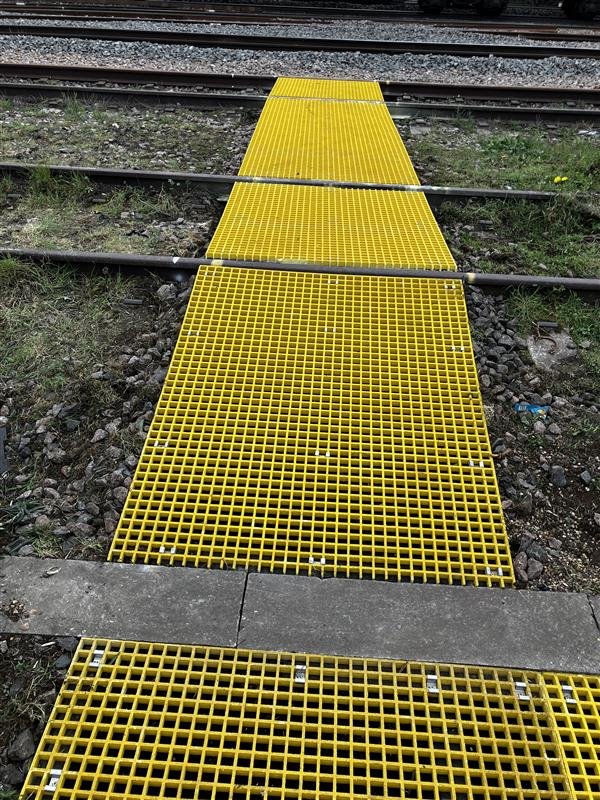
Key takeaways:
Ezi Klamp’s composite plastic timber walkway system provides a robust, versatile, and long-lasting alternative to traditional timber. It’s made using recycled plastic, helping to turn waste material into solid composite profiles that you can cut, drill, and work in a similar way to timber. It’s particularly suited to lighter-duty walkways, sub-bases, edges, and outdoor access areas where you need a solution that’s quick to install and will stand the test of time, without risk of rotting.
Did you know that wet rot is responsible for nearly 90% of timber decay in buildings? If timber has a moisture content above 20%, it becomes much more vulnerable to fungal decay, which can weaken the material, shorten its service life, and lead to costly repairs.
If you’re working on a rail, civils, or outdoor access project, this is an issue you can’t afford to overlook. Traditional timber may be easy to work with – but it can quickly become a weak point in your walkway or support structure if you’re operating in wet or poorly drained areas.
This is why Ezi Klamp has launched its new composite plastic timber walkway system. Developed following a request from Network Rail, it gives you a much longer-lasting alternative to traditional timber for lighter-duty applications, with the added benefit of faster installation and reduced possession time. You can cut and drill it like timber, but because it’s made of recycled plastic, it won’t rot when exposed to moisture.
In this article, we explain what our new composite plastic timber system is, where it can be used, and why you should consider it for your upcoming project.
What is composite plastic timber and where can it be used?
Composite plastic timber is manufactured by breaking down and reprocessing waste plastics into solid timber-style profiles. These profiles are then moulded into a wide range of shapes and sizes, creating a strong and versatile material that can be used as a replacement for traditional timber in many outdoor applications.
We originally created the product following a Network Rail request. However, its potential uses go far beyond just rail. It’s well suited to a variety of outdoor environments where standard timber would be exposed to moisture, repeated use, or ground contact.
For rails and civils projects, composite plastic timber can be used for:
- Lightweight access platforms
- Walkway support structures
- Sub-bases for GRP walkways
- Edging strips for Type 1 MOT gravel paths
- Embankment retention systems
Aside from rail, it’s also suitable for the following outdoor applications:
- Public access routes
- School playgrounds
- Landscaping structures
- Outdoor furniture
- Other high-traffic public spaces
Why choose composite plastic timber for your project?
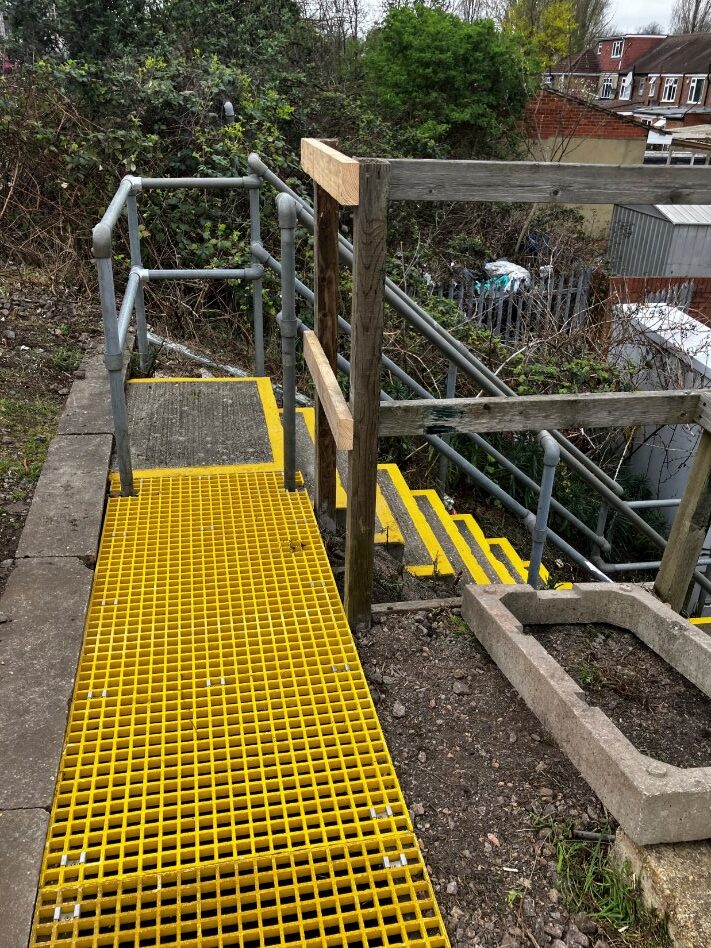
1) No rotting, unlike traditional timber
Timber is highly susceptible to rotting in wet environments. Composite plastic timber is made from recycled plastic rather than natural wood fibres, meaning it will not rot. This makes it an ideal option for your project if moisture exposure is unavoidable.
2) Can be worked in a similar way
Traditional timber is exceptionally easy to work with. Composite plastic timber can be worked in a similar way, meaning you can cut, drill, and install it using conventional methods. It can be easily adapted to your specific site requirements without complex fabrication.
3) More affordable than GRP
GRP is an excellent choice for higher-load, demanding applications – but your project may not need that level of performance. Composite plastic timber is a more cost-effective choice for lighter-duty walkways, edging, support structures, and access routes.
4) Quick and easy to install
Composite plastic timber can be quickly installed on-site without extensive manual labour or specialist tools. This reduces your team’s time on-site and supports short possession windows, which is useful if access time is limited on your project.
5) Delivers exceptional long-term value
Although composite plastic timber can cost more than traditional timber upfront, it typically lasts much longer. You won’t need to pay for expensive repairs or maintenance bills, giving you a much stronger return on investment over time.
6) More sustainable than traditional timber
Composite plastic timber is made from recycled plastic, which helps to give waste material a second life. It’s an ideal material option if you’re looking to improve your project’s environmental performance, without compromising on durability or usability.
Composite plastic timber vs. traditional timber
| Feature | Composite plastic timber | Traditional timber |
| Moisture resistance | Will not rot when exposed to wet or damp conditions | Absorbs moisture, making it vulnerable to rot and deterioration |
| Installation | Can be cut, drilled, and installed using familiar methods | Easy to cut and drill, but may require treatment or protection |
| Service life | Provides a longer-lasting option for outdoor access applications | Service life can be reduced in exposed or high-moisture conditions |
| Maintenance | Easy to maintain with no concerns around decay | May require regular inspection, repair, or replacement |
| Project suitability | Ideal for lighter-duty walkways, sub-bases, edging, and outdoor access routes | Suitable for some applications, but not for wet or demanding environments |
| Whole-life value | Higher upfront cost than timber but has a longer service life | Lower upfront cost, but can be expensive to maintain and repair |
| Sustainability | Made from recycled plastic, giving waste material a second life | Natural material, but performance depends on timber quality and treatment |
See our composite plastic timber system in action
Our composite plastic timber walkway system has already been used across three major railway installation projects.
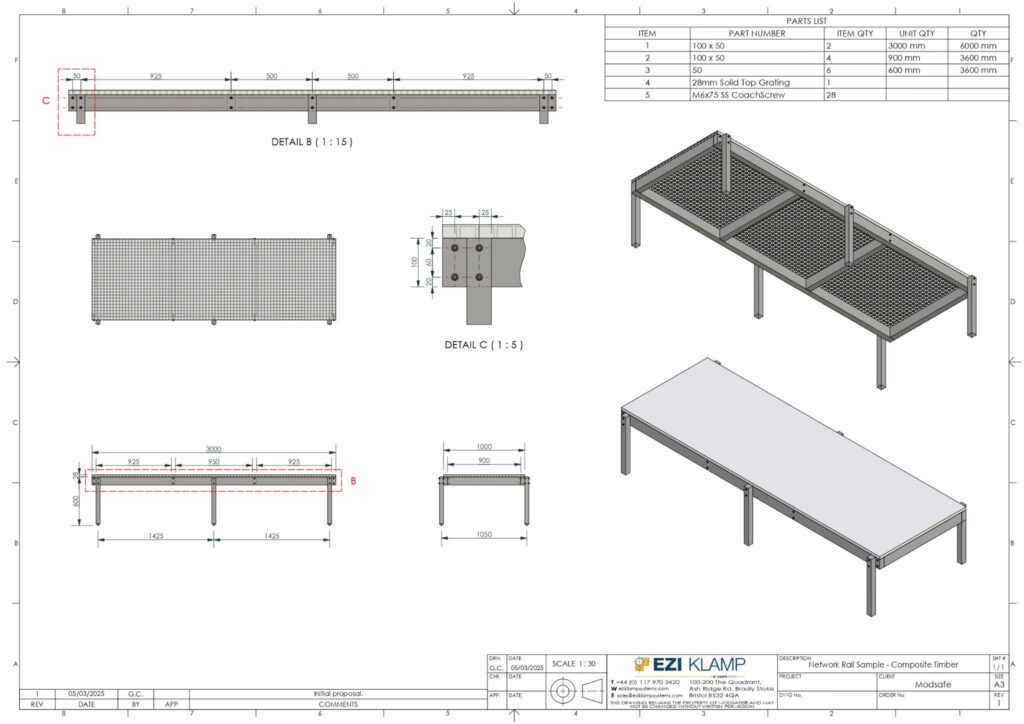
We produced several walkway arrangements for Network Rail using 3,000mm modular units, 100 x 50 composite timber sections, 28mm solid top grating or 25mm open mesh grating, and stainless steel coach screws. These components helped to create a robust, workable access solution that could be efficiently installed on-site with minimal disruption.
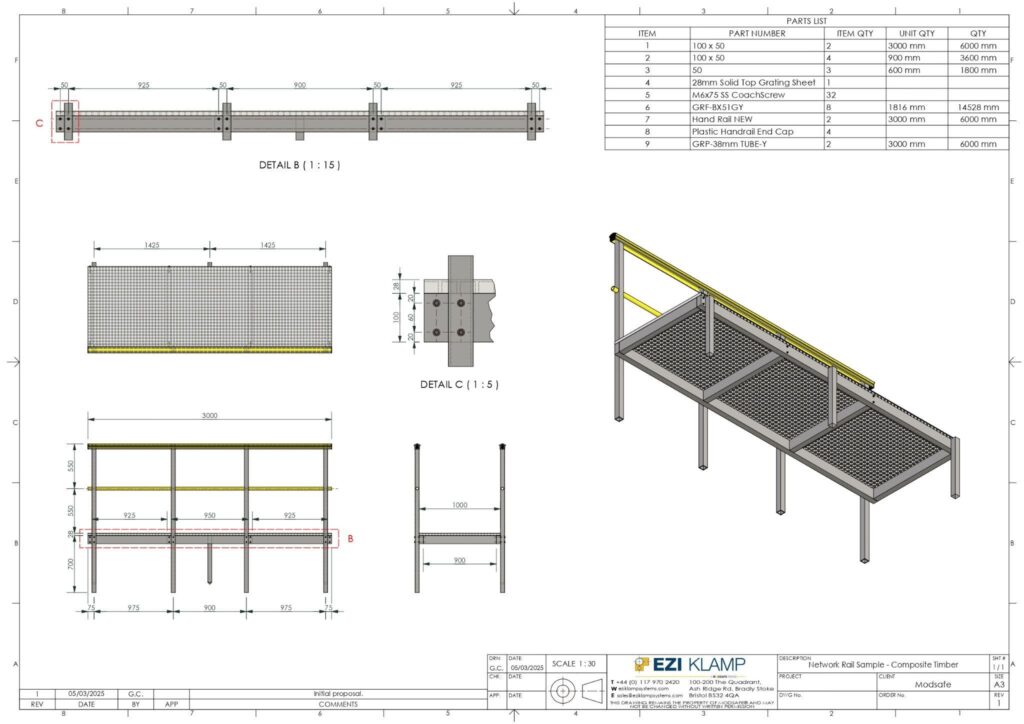
We also delivered walkway options with integrated handrail provision, combining the composite timber structure with handrail components, GRP handrail end caps, and GRP tubing.
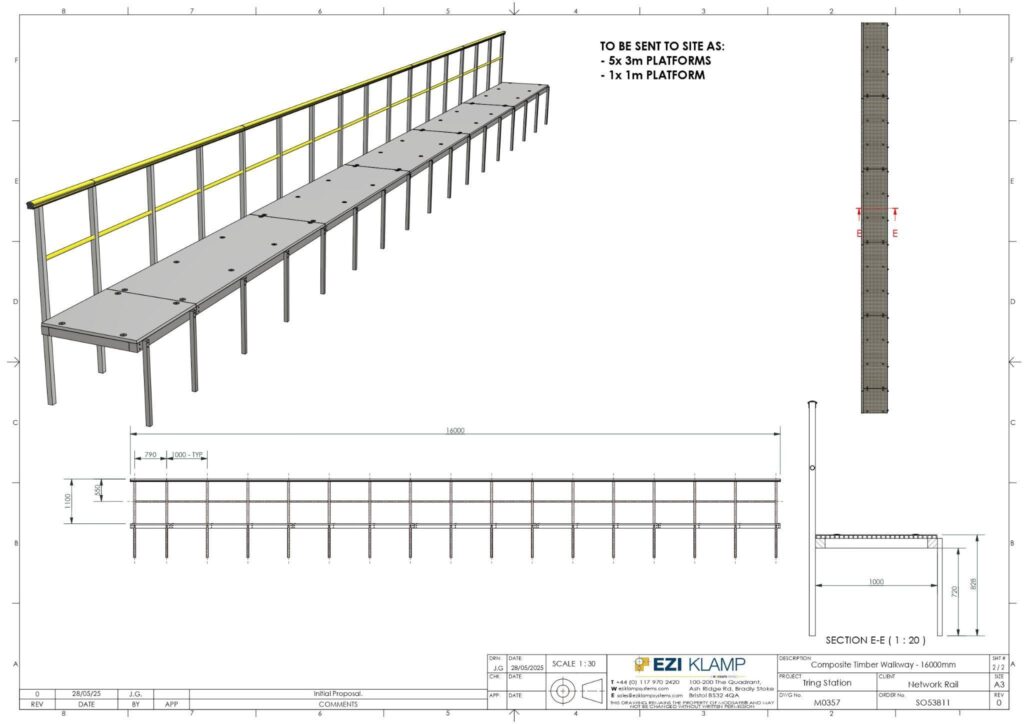
Finally, we also created a proposal specifically for Tring Station, which shows a 16,000mm composite timber walkway supplied as five 3m sections and one 1m section. This demonstrates how the system can be adapted to suit longer access routes and project-specific layouts.
Looking for a durable alternative to traditional timber?
If you’re currently planning an outdoor access project and are concerned about using traditional timber, our composite plastic timber walkway system gives you a much more durable and cost-effective alternative. You get the familiar workability of timber, but without the expense and hassle of maintenance or repair work.
We can supply our composite timber system in a range of common stock sizes, typically held in 3m lengths. But if you have something specific in mind, we can also offer bespoke sizes tailored to your application. Our system can also be combined with other access components, such as solid top grating and handrail arrangements, depending on your project requirements.
Want a material that’s built to last for your upcoming outdoor access project? Get in touch to discover whether our composite plastic timber system is the right fit for you.
FAQs
Is composite plastic timber suitable for rail projects?
Yes, composite plastic timber is suitable for lighter-duty rail applications, including access walkways, sub-based, and edging systems. Ezi Klam’s system was developed following a request from Network Rail and has been used across several completed railway projects.
How does composite plastic timber compare with traditional timber?
Composite plastic timber can be cut, drilled, and installed in a familiar way to traditional timber, but it will not rot when exposed to moisture. This makes it an ideal long-term option for outdoor projects where timber may degrade or create ongoing maintenance concerns.
Is composite plastic timber a replacement for GRP?
Composite plastic timber is not designed to replace GRP – GRP remains the better choice for higher-load or more demanding access requirements. However, composite plastic timber provides a practical, lower-cost alternative for lighter-duty projects.